Pages

Thursday, 18 July 2013

Lightening Strike

Canadians have a particular fondness for talking about the weather and I'm no exception. The past few days have been pretty hot around here. This isn't news - most of eastern North America and the UK is baking in the heat so this isn't something you don't already know. Yesterday I think it was 40 C here (104 F). Not bad for the Great White North eh? Now don't get me wrong, I'm one of the ones who likes it hot but even I have to admit that this is a little much.

This kind of heat also triggers thunderstorms around here. Big, nasty thunder-boomers. And today was no exception.  About 2:30 we could hear the thunder rolling and by 3:00 we shut the internet down. And then the storm rolled right down the street. The noise was unbelievable - there were several lightening strikes very close to here and one in my front yard! My poor lilac tree has had a tough go of it. Drought last year, torrential rain this year and now its had a big branch blown off from lightening and another section incinerated on the tree!


Yes, they're slightly out of focus - I was just about carried away by mosquitoes (which are about the size of eagles this year from the rain).

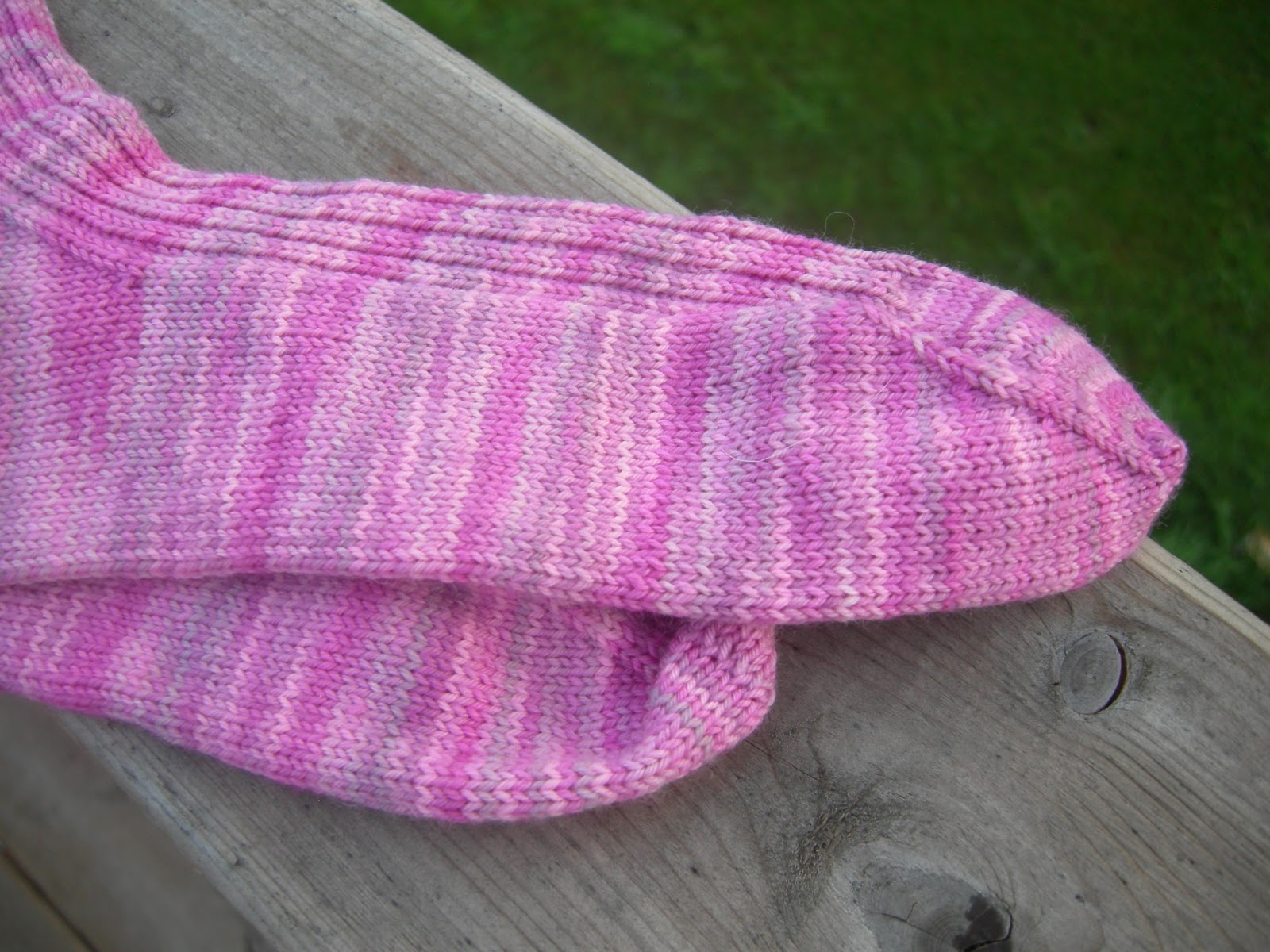
I also have a new pair of socks.  The Strawberry Swirl socks that I was working on are now done.


I usually wear my new socks right away but I don't think I'll be doing that tomorrow.  Forecast high is 32 (90F) with a humidex value of 43 (110F).  I'll live without wool socks.

And as I was outside taking these pictures I saw this:

The storms aren't over yet.

Sunday, 7 July 2013

Flutter

I have something new to share with you, and it isn't another pair of socks!  After flipping through a copy of Knit to Flatter by Amy Herzog at a friend's place a few weeks ago (Thanks M!) I bought a copy for myself.


Like most women I know, I'm not Ms. Average so I have to adjust sweater patterns in some way, but I don't have a lot of confidence in my ability to do so.  I think it's because in order to do it well, I need to have a better knowledge of garment construction.  This book shows how and where to calculate the adjustments, which adjustments are easiest and which you should really leave alone and how to play up features to their best advantage.

So here is Flutter.  This is a pullover with a boat neck and elbow length sleeves.  Most of the sweater will be knit in stockinette stitch but there is a dainty cable pattern running up both sides of the body that is repeated on the sleeves. So far, so good.  The challenge is that it is knit in what is essentially sock yarn.  Think about that for a minute - a sweater knit in sock yarn.  I'm not a petite person.  I'm certainly not the first to knit a sweater at this gauge, but it's the first time I've ever done this.  This is what I've done so far.


Note - if you're thinking of making this, there is an errata page from the publisher here - you want to see this, the chart in the book is wrong.

In totally unrelated news, the strawberry season is well underway here and farmer's have been saying that this is the best crop they've had in years.  And the farmer's are right - this year's berries are divine!  I stopped and bought two 4 L baskets from a roadside stand on Thursday.  One basket became jam:


 The other will be used for straight eating.   Next up - raspberries!

Tuesday, 2 July 2013

Review - Follow the Yarn

I recently found myself saying yes to the opportunity to review an as-yet unpublished book called Follow the Yarn by Reba Linker which chronicles the writer’s experiences while taking a beginner knitting class at the Central Queen’s Y from teacher Ann Sokolowski.  Part philosophy, part technical manual, part biography and part autobiography, the book started as a means to preserve the knitting wisdom passed onto students but morphed into so much more.

As a knitting book, it isn’t a comprehensive “how-to” like many of the other big name books on the subject and the author freely admits that there are gaps in the content.  For example, there is almost no discussion of how to cast on and only a passing discussion of blocking; the reader is instead pointed to the internet to consult online tutorials. In contrast, there are whole sections dedicated to the technique of working a handful of different stitches.  The book goes on to cover such topics as increasing and decreasing, binding off, the sources and properties of various fibres, a discussion of different needles and my personal favourite, why you should pull yarn from the middle of the ball.

One of the things I found most interesting is that Ann taught Continental style knitting rather than the English style (called American style in the text) which is more common in North America.  As a result, the text and graphics around how to work the basic knit and purl stitch support this Continental style and I think would be of limited use to the average North American, English style knitter.  That being said, there is no reason not to learn another technique and in fact, many good reasons to at least have a nodding acquaintance with “the other” style.   

But if you already know how to knit; if you already have a foundation in the mechanics of sticks and string there is a surprising wealth of information in this book.  In many cases, I already knew the tip being presented.  In some cases, I was aware but hadn’t really verbalized it.  Others were totally new – something exciting for me after 13 years of knitting!  There is a good section on working seams and how to engineer the edges of your knitting to lie flat and therefore to have a better seam, a discussion of what should be in your knitting bag and an interesting exploration of the theme and variations of a simple basket weave stitch.

Knitting however, is only part of the story.  A great deal of this book is Ann’s story; her life and the events that made her who she was as told by Reba.  It isn’t a biography in the traditional sense.  There is no examination of her childhood, though there are a few photos.  There is a brief mention of her professional life that left me wanting to know more.  This is really about Ann’s knitting life which spilled over into her professional life and coloured everything. 

The real surprise though is what the book did for the author.   What started as a project to tell Ann’s story became a means to allow Reba to work through some long-standing issues of her own.  Sometimes painfully raw, you can see the hurt and the healing happening.  Some of what I came to think of as “Reba’s Story” becomes repetitive but by the end of the book, you don’t remember the repetition.  You remember a gift of healing, a gift of being seen, of being heard and of being valued.  You have a sense that you know Ann, a gruff New Yorker with a heart of gold. Finally, there is a great sense of peace, and you just know that your knitting is going to get better.

-------------------------------------------------------------------------------------------

Follow the Yarn will be published in paperback this fall, and will be available at Amazon.com and BarnesandNoble.com 

Until then, readers can get a pdf copy of Follow the Yarn by donating as little as $5 to our Indiegogo campaign at http://www.indiegogo.com/projects/follow-the-yarn/x/3505993 (campaign ends July 9), or they can get a FREE CHAPTER of Follow the Yarn by signing up at: http://eepurl.com/A6w8v   (emails will be kept strictly confidential - they will NEVER be given to a third party)

Last but not least, readers can learn more at http://www.RebaLinker.com

Saturday, 29 June 2013

WIP Update

I was planning to have this up earlier in the week but I was stalled by a dead battery in my camera.  Then I had the battery charged but there were severe thunderstorms in the area for days so my internet was sporadically shut down.  I have a line-of-sight tower which is like a lightening rod on my house.  Which has a steel roof.  It's just easier to shut it down than replace electronics.


So finally I have a charged battery and the storms are passed so without further ado, here is what is happening around here.

Socks.

Yeah, I know.  I'm always knitting socks.  But I like the instant gratification of socks - especially when they're for me.  These are knit in a lovely hand dyed fingering weight from Art-By-Ana of Smiths Falls, Ontario.  And like just about everything else I've ever made, the yarn colours pool into a spiral.  I don't dislike it, and I'm sure somebody will absolutely adore it, but sometimes I'd like to have it really be variegated.


So I gave this some thought. There are two basic ways to colour yarn.  You can dye it as above into the colours of your choice or you can select fibre of different colours and ply the different singles together to make a multi-coloured yarn like this:


The colours aren't good here, but there is a white/natural, a black and a tan.  Unfortunately, I can't tell you what kind of wool this is.  The fibre came out of a big bag from the wool coop simply labeled "wool".  But ya know, for $5.00/lb I'm not going to complain too loudly.  What I didn't expect was how soft the finished item would be.  Granted, the skein was roughed up somewhat in the tub between hot and cold water and beaten against the wall but still, it's much softer than I expected it to be.


The skein in this photo is 75g / 225yards so it's a little heavier than a sock weight (that's a dime in the first photo) and there is more on the bobbins to ply so I'll have lots.  But I bet the colours in this yarn won't pool!

Sunday, 23 June 2013

What Makes Something Too Hard?

I was in Almonte yesterday to sit in a knitting group that I knit with when I can. A lady who has only been part of the group for a short while brought a friend with her.  The friend appeared to be an experienced crocheter, but a fairly new knitter. After she "oohed" and "aahed" at everyone's work in progress she said that she really admired those of us who could make socks because they were so hard - there were at least four of us with socks in various stages of completion. She went on to say that she had taken several classes but never completed any of her socks; she had worked the leg, knit the heel flap and turned the heel, but never knit the foot. So she was waiting until the fall for the next class when hopefully she would be able to actually finish the sock.

But she didn't have just one sock like this. She had four. I was a little taken aback at this, after all - the heel is usually considered the "hardest" part and that was done. So what was the problem? You pick up the stitches and decrease down until you have the same number of stitches as you started with (at least this is how I do it), knit to desired length of foot and decrease for the toe. Graft to finish.

And then it hit me - sure, its easy for me to say this, but I've probably knit 20 pairs of socks. I know where to put the decreases - and what matched set of deceases to use. I know how to measure to ensure my socks fit me. I know what decrease method to use for a toe that I like. I know how to graft the toe to get the finish I want. In other words, I have enough familiarity with the techniques to actually complete the project.

So what this lady was really saying was she didn't know how to finish her socks. And saying "I don't know how" is very different than saying "It's too hard".  I hope she comes back next week - I'd like to take the time to show her how to finish her socks because there is really nothing hard about it.

This reminds me of an interview I read several years ago with cellist Ofra Harnoy where she commented on learning to play the cello. Because nobody around her had ever said that playing a cello is difficult, she didn't know it was. She simply played the music - and made her professional debut at age 10.

Think about it. What else do you avoid because someone else said was "too hard".  I only made jam and pickles for the first time last year because:
  a) I was put off by all the warnings about the danger of old recipes and
  b) I didn't know how.  (It's as easy as boiling water in case you wanted to know).
I avoid most home improvement-type projects because of a lack of confidence.
The only thing I can do with my car (other than drive it) is put gas in and top up the wiper fluid.
I really want chickens but don't know how to raise them so I'm thinking of all kinds of reasons not get get any.  That, and this isn't like messing up a sock - it's a living animal.
And I've put off buying a fleece because I don't know how to process it.  That my friends is going to change. The wool depot is just down the road, I know where to get combs and I can use YouTube.

Sunday, 16 June 2013

Lambs Down Park Festival

Yesterday I attended the third annual Lambs Down Park Festival in Carleton Place, ON on the grounds of the Canadian Wool Growers Co-op.


The Co-op was established in 1918 as a means to collect, sort and grade the wool grown in Canada and market it to the rest of the world.  In global terms, Canada is not a large producer of wool, though I was surprised to learn that 3 MILLION pounds of fleece goes through this warehouse each year. 


Most of what is produced is shipped overseas for processing - mostly to China; only about 10% remains in Canada.

But that 10% is good stuff.

I bought two batts (100 g) of Blue Faced Leicester dyed by Judy Kavanagh.  This has been naturally dyed using madder and cochineal so doesn't have that nasty chemical smell that yarn so often has.


I picked up some sock yarn dyed by Art-By-Ana of Smiths Falls.  Ana's studio is very close to me and she has some gorgeous colours.  I didn't take a picture, but check out the Sock Garden Party Cakes on her Etsy store.  Fantastic stuff!


And I discovered something new.  I'd like to introduce you to a new company called Trailhead Yarn and Fibre.  Their mission is use Canadian grown and processed wool - something I can get behind and support.  The yarn I bought was grown in Alberta and milled in Osgoode, ON.  Osgoode is about 70 km from my house.  I had no idea there was a wool mill there!  Might have to take a trip out someday.


This yarn is about a fingering weight with a fairly loose ply which gives it the slightly crimped texture you can see.  I think it will make a stunning scarf for the fall.

This is a very small festival, but I'm already looking forward to going back next year.

Thursday, 13 June 2013

And Out the Other Side

It's done.  The garden is planted for another year and I now feel like I have my life back.  It took about six weeks to get everything in, there was foul weather to contend with, a late frost on what was supposed to be my "safe planting" day (May 24 in case you're wondering) and an incident involving grass clippings, a wheelbarrow and rain.  So here is a sampling of what I planted.

Italian Peppers, Cayenne Peppers and Sweet Peppers

Potatoes.  These are yellow fleshed from PEI, not russets like I wanted, but
I was late  buying them so I'll be happy with what I can get.

Beans.  I'm planning to dry these for baked beans in the winter.

Red Cabbage.  This makes the best coleslaw at Christmas.

Celery.  I don't often buy celery, but I use loads of it when I grow it myself.

Chives.  This goes into just about everything.

Sage.  I've never had sage flower before.

Crab apples.  I might get enough to make a few jars of jelly.
So a word about grass clippings.  My son is 12 now and we figured he was old enough to push the mower around the yard up near the house.  So we put the bag on the mower to catch the grass clippings, told him to keep his feet away from the blades and let him loose.  When the bag was full, I told him to dump it into the wheelbarrow because I wanted the clippings in the garden to use as mulch.  He ended up with four or five bags full of clippings and I didn't get this into the garden right away.  Then it rained.  A lot.  Then it was really sunny for a day or two and I still didn't get the grass into the garden.  By this time the grass/mulch was no longer green - it had turned brown.  Then it rained again.  Then my husband wanted the wheelbarrow so I said I would go deal with the grass.

The first few handfuls weren't too bad.  But as I got below the top layer there was a smell.  Not a nice "fresh cut grass" smell but a "what the hell died in here" smell.  But Chuck needed the wheelbarrow and I needed mulch so I kept going.  The smell got worse.

A word about anaerobic decomposition - You can stop a train with this.  The smell truly defies words.  I was just about gagging on it as I spread the rest of the grass and gave serious thought to burning the leather gloves I was wearing and I'm sure there was much speculation among the neighbours about what exactly I was doing with that shovel.

But you know what - I have no marauding critters in the garden.  I also switched to plain old straw for the remainder of the mulching.